Last updated August 3, 2026
The last thing many guests do on their first night is step out onto the lawn, look up, and go quiet. Downeast Maine has some of the darkest night skies left on the eastern seaboard, for a simple reason: almost nothing sits east of here. Beyond the bay there is open ocean to the horizon, and no city glow comes off the water. What follows is how to use that darkness, starting at the bottom of the lawn.
From the shorefront
The house's own dark corner
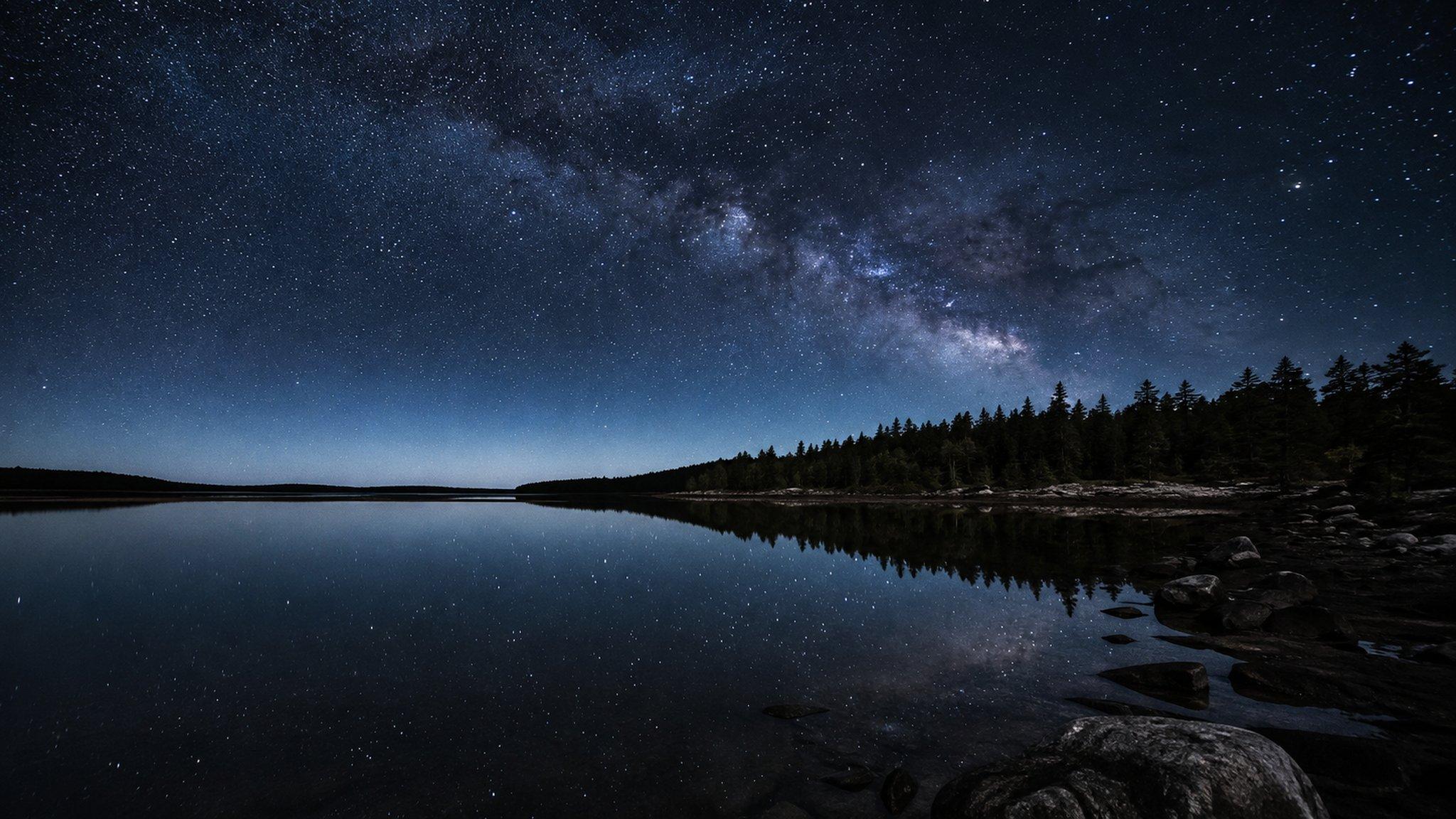
Walk down toward the water, away from the house lights and any glow from the road, and let the shore do the work. On a clear, moonless night the Milky Way shows itself here, a grainy band arcing over the bay, and the longer you stand there the more stars resolve out of it. This is what the property's own notes mean by "stars you don't get at home." Bring a blanket and a warm layer, because even August nights on this shore run cold; kill every flashlight, and give it time. The fire-pit end of the lawn works too, once the flames die down. And on the nights the moon is up, it earns its keep: moonrise over the water is its own quiet show from the lawn. One note: the shore below is tidal and the rocks are unlit, so know where the water is before you settle in. Tides & the shore covers how the ten-foot range moves.
Getting the conditions right
Three things decide whether the sky performs:
- The moon. A bright moon washes out everything faint. Aim for the nights around the new moon, or the hours after moonset.
- The air. The first clear night after a cold front is often the best of the week: dry, transparent air and the haze scrubbed out.
- Your eyes. Full dark adaptation takes twenty minutes or more, and one glance at a phone screen resets the clock. Use a red light if you need one, and be patient.
Darker still: into the park
The shorefront is very good. For the full effect, drive into Acadia after dark:
- Sand Beach and the Ocean Path pullouts — lie back on the sand with surf for a soundtrack, or pick a pullout along the shore road; the headlands frame a wide slab of sky.
- Jordan Pond — the still water doubles the stars on a windless night.
- Cadillac Mountain — the highest, widest sky in the region. In season, driving the summit road takes a timed vehicle reservation; the details live in Getting a Cadillac Summit Reservation.
- Schoodic Point — the mainland arm of the park, with a horizon that faces open ocean and nothing else. Arguably the darkest easy-to-reach sky in the area; see around the bay for the drive.
For orientation to the park itself, passes and roads, start with our first-timer's guide to Acadia.
The Acadia Night Sky Festival
Every September, the area celebrates its darkness with the long-running Acadia Night Sky Festival: talks, guided stargazing, and telescope sessions across the park and the surrounding towns. Dates and events vary by year, so check the current program if your stay lands in September. It's one of the few festivals anywhere whose main attraction is turning the lights off.
About the northern lights
The aurora does reach Maine, and during strong solar activity it is occasionally visible from dark, north-facing shores here. But it's an occasional gift, not a feature; nobody can promise it on a given night. If a strong geomagnetic display is forecast, find a dark spot with a clear view north and hope. The Milky Way, the planets, and the meteors are the reliable show; the aurora is the encore that sometimes happens.
Common questions
Can you see the Milky Way from Eagles Nest?
Yes, on clear, moonless nights the Milky Way is visible from the shorefront below the house, away from the house lights. Downeast Maine keeps some of the darkest skies on the eastern seaboard because there is only open ocean to the east. Give your eyes twenty minutes or more to adapt, and avoid phone screens.
Where is the best stargazing near Acadia?
From the house, the shorefront at the bottom of the lawn is the easy answer. In the park, Sand Beach, Jordan Pond, and the Cadillac summit are the classic spots, and Schoodic Point on the mainland side has arguably the darkest easy-to-reach horizon in the area. Cadillac's summit road requires a timed vehicle reservation in season.
When is the Acadia Night Sky Festival?
The festival runs in September each year, with talks, guided stargazing, and telescope sessions across the park and nearby towns. Exact dates and events change from year to year, so check the current program when planning a September stay.
Can you see the northern lights in Maine?
Occasionally, during strong solar activity, the aurora is visible from dark, north-facing spots in Maine. It is never guaranteed on a given night, so treat it as a bonus rather than a plan, and watch the forecasts for geomagnetic activity during your stay.
What conditions make for the best stargazing?
Three things: a moonless sky, so aim for the nights around the new moon; clear, dry air, with the first clear night after a cold front often the best of the week; and dark-adapted eyes, which take twenty minutes or more with no white light. Get all three and the sky over the bay does the rest.