Last updated August 3, 2026
Between the mountains and the ponds in the middle of Acadia runs a network you can't drive: 45 miles of crushed-stone carriage roads, built between 1913 and 1940 under John D. Rockefeller Jr., who wanted a way through the park without automobiles. He got it. A century later the carriage roads are still car-free, still immaculately graded, and still the gentlest way to spend a whole day inside the park, on foot, on a bike, or behind a horse.
They are also the answer to a question every family eventually asks in August: where can we go that is beautiful, easy, and away from the traffic? This is where.
What they're like
Wide, graded gravel through the park's quiet middle
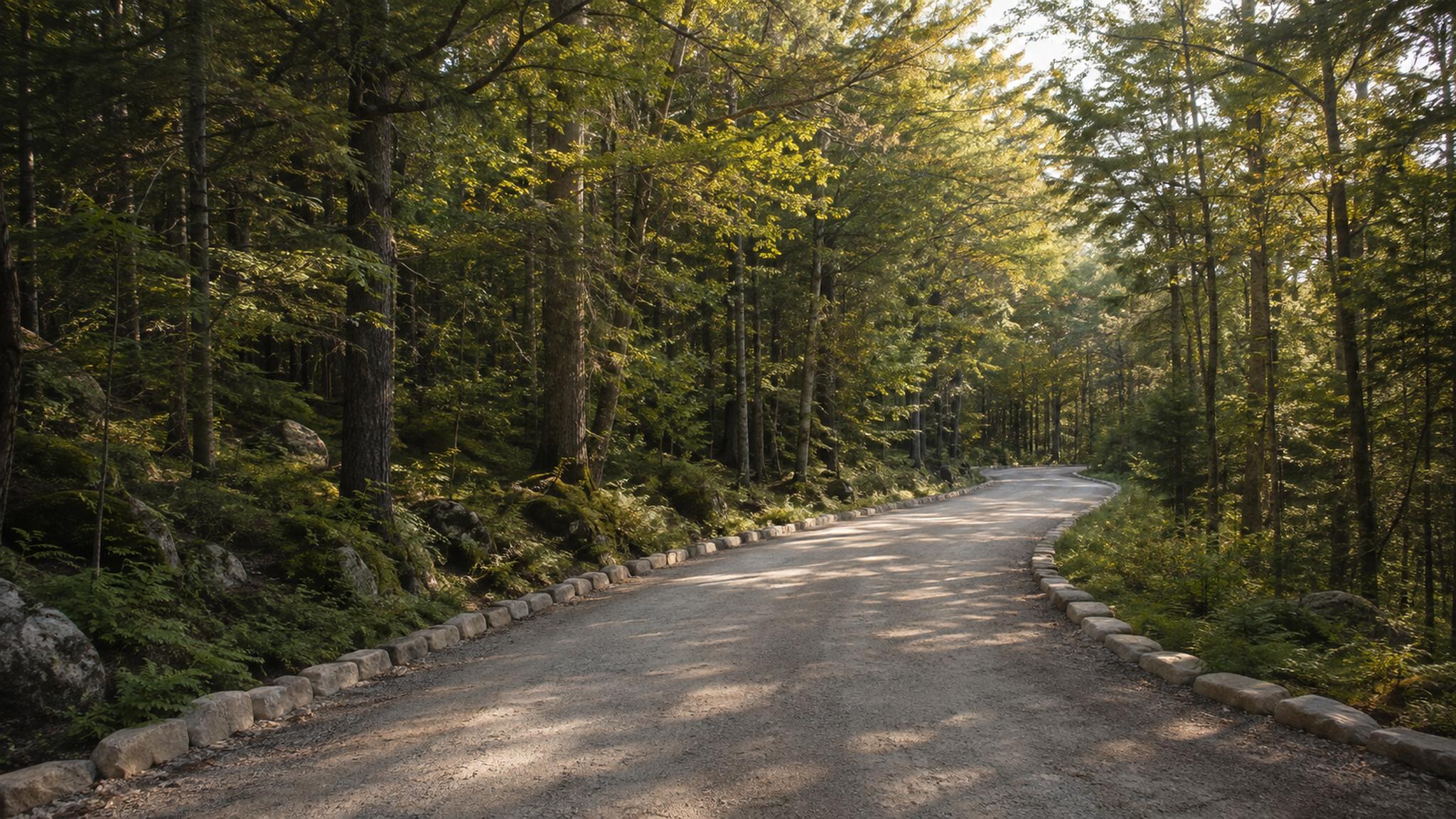
Think of a gravel lane wide enough to walk four abreast, winding past ponds, under wooded slopes, and over 17 stone-faced bridges, each one different, arching over streams, waterfalls, and roads. Grades are gentle by design; the roads were engineered for horses, and what suited a carriage horse suits a seven-year-old on a bike. There are no cars, ever. Intersections are numbered on wooden signposts, which makes navigation simple: pick up a carriage-road map at Hulls Cove Visitor Center and follow the numbers.
Riding the carriage roads
The best family biking in the park, by a wide margin
Biking is what most visitors come for, and the classic first ride is the Eagle Lake loop, about six miles of water views and easy grades around the lake. Stronger riders can link loops toward Jordan Pond, arriving for popovers as the reward, which is the kind of bribe that gets teenagers up in the morning; the pond and its popovers appear in best hikes too.
The rules that matter: class-1 e-bikes are allowed, class 2 and 3 are not, and everyone on wheels yields to horses and to people on foot. Keep speeds modest and call out before passing. Bike rentals are available in Bar Harbor in season; in summer the fare-free Island Explorer runs a bicycle-express service toward Eagle Lake, so check the current routes when you plan, or simply drive to a carriage-road lot and start there.
Walking and running them
The flat miles the mountain trails can't offer
Every mile of carriage road is open to walkers, and for anyone in the group who wants distance without scrambling, they are the park's best offer: stroller-friendly surfaces, shade, and water views without a single trail ledge. They also make a fine rainy-day outing, since gravel drains better than granite, and an early-morning run on them beats any treadmill in Maine.
The horse-drawn version
Seeing the roads the way they were designed to be seen
The carriage roads were built for horses, and Wildwood Stables, inside the park near Jordan Pond, still runs horse-drawn carriage rides along them in season, passing the stone bridges at the speed they were designed for. It is the version grandparents and small children tend to remember longest. Schedules and fares change season to season, so check Wildwood's current offerings before you promise the family a carriage.
In winter
When snow cooperates, the carriage roads become the park's cross-country ski and snowshoe network, one of the few parts of Acadia that gets better after the Park Loop Road closes for the season.
From the house
The carriage-road system sits in the middle of MDI, so access runs through the park entrance, about 25 minutes from Eagles Nest to Hulls Cove, then a short drive to whichever lot anchors your loop; Eagle Lake's lot is close to the entrance side. Summer middays fill the popular lots, so go early or ride the shuttle; the same advice as everywhere in Acadia, covered in getting here & drive times.
Common questions
Can you ride bikes on Acadia's carriage roads?
Yes, biking is the classic way to see them: 45 miles of car-free crushed-stone roads with gentle grades and 17 stone bridges. Class-1 e-bikes are permitted; class 2 and 3 are not. Riders yield to horses and pedestrians. The Eagle Lake loop, about six miles, is the standard first ride for families.
Are the carriage roads good for kids?
They are the best family riding and walking in the park: no cars at all, wide graded gravel, gentle grades engineered for carriage horses, and numbered signposts that make navigation simple. A child who can manage six miles of easy pedaling can do the Eagle Lake loop.
Who built the carriage roads in Acadia?
They were built between 1913 and 1940 under John D. Rockefeller Jr., who financed and closely directed the network so the park could be traveled without automobiles. The 17 stone-faced bridges and the graded crushed-stone surfaces are original to that effort and still maintained today.
Can you take a horse-drawn carriage ride in Acadia?
Yes. Wildwood Stables, located inside the park near Jordan Pond, runs horse-drawn carriage rides on the carriage roads in season, which is how the roads were meant to be traveled. Schedules and fares vary by season, so check Wildwood's current offerings before building a day around it.
Are e-bikes allowed on the carriage roads?
Class-1 e-bikes, pedal-assist only, are allowed on the carriage roads. Class-2 and class-3 e-bikes are not permitted. All riders share the roads with horses and walkers and are expected to yield to both and keep speeds modest.